





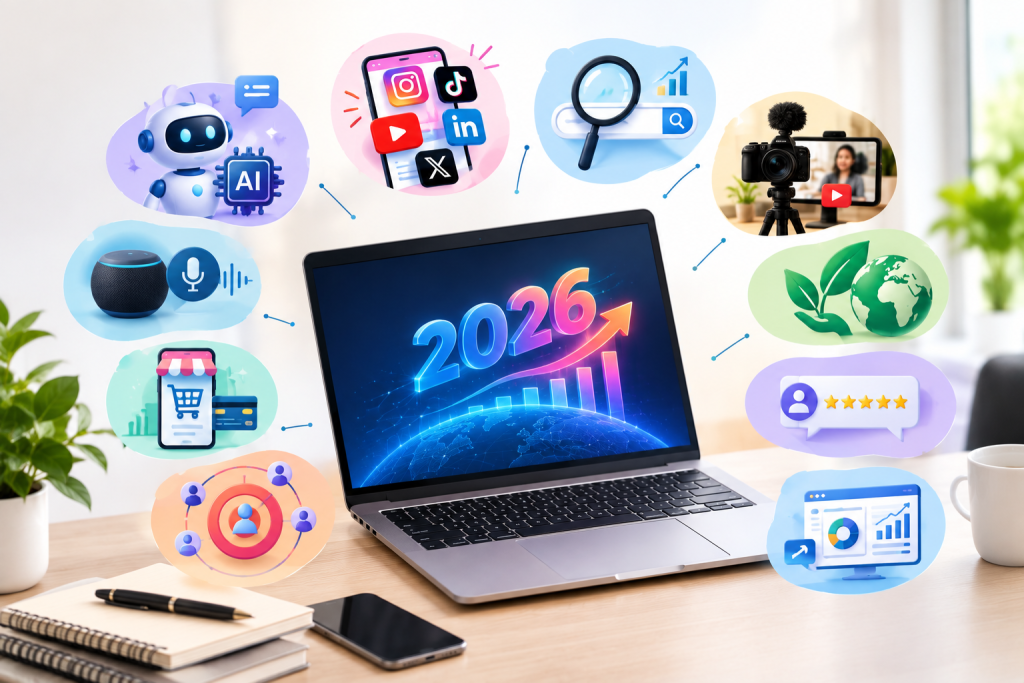

Digital Marketing Trends Businesses Should Watch in 2026
Digital marketing continues to change rapidly, and 2026 is bringing major shifts in how businesses reach, engage, and convert customers.
Artificial intelligence, changing search behavior, short-form video, personalization, social commerce, and data-driven marketing are becoming increasingly important. At the same time, businesses need to focus on authenticity, customer trust, and creating useful content.
Understanding these trends can help businesses adapt their marketing strategies and stay connected with their target audience.
Here are 10 digital marketing trends businesses should watch in 2026.
1. AI-Powered Marketing
Artificial intelligence is becoming an important part of everyday marketing.
Businesses are using AI to help with:
- Content creation
- Customer segmentation
- Data analysis
- Marketing automation
- Ad optimization
- Customer support
- Content personalization
AI can help businesses save time and scale their marketing activities. However, human creativity, strategy, fact-checking, and brand oversight remain important.
The goal should not be to replace human marketing completely, but to use AI to make marketing workflows more efficient and personalized. HubSpot’s 2026 research identifies AI-powered personalized content as one of the leading marketing trends
2. AI Search and the Evolution of SEO
Search is changing.
People are increasingly using AI-powered search experiences and conversational queries to find information. This means businesses need to think beyond traditional keyword-based SEO.
Content should provide clear answers to real questions and demonstrate expertise and credibility.
Businesses should focus on:
- Helpful, original content
- Question-based topics
- Clear answers
- Strong website structure
- Relevant keywords
- Authoritative information
- Brand mentions across trusted sources
Traditional SEO is not disappearing, but it is expanding into a broader search environment that includes AI-generated answers and other discovery platforms.
3. Short-Form Video Continues to Grow
Short-form video remains one of the most important content formats in 2026.
Platforms such as Instagram Reels, YouTube Shorts, and TikTok give businesses opportunities to reach audiences through quick and engaging videos.
Businesses can create videos such as:
- Quick tips
- Product demonstrations
- Tutorials
- Behind-the-scenes content
- Customer stories
- Educational videos
- FAQs
You don’t always need expensive equipment. Useful, authentic, and relevant content can be more valuable than highly polished production. HubSpot’s 2026 research identifies short-form video as a leading format for marketing ROI and investment
4. Personalized Marketing
5. Social Media Becomes More Than a Marketing Channel
Social media is increasingly becoming a place where customers discover brands, search for information, communicate with businesses, and make purchases.
Businesses can use social platforms for:
- Brand awareness
- Customer service
- Product discovery
- Community building
- Social commerce
- Influencer collaborations
- Lead generation
This means businesses should not treat social media simply as a place to publish promotional posts. Building genuine conversations and relationships can be equally important.
6. Authentic Content Matters More
7. Social Search Is Growing
People are increasingly using social platforms to discover products, services, ideas, and businesses.
This means businesses should think about how their content appears when people search within platforms.
To improve social discoverability:
- Use relevant keywords in captions
- Create content around common questions
- Optimize your profile
- Use descriptive titles
- Add relevant hashtags where appropriate
- Create educational and searchable content
Social media content should be created not only for followers but also for people who may discover your brand through search
8. Data-Driven Marketing
Successful marketing requires more than creativity. Businesses also need to understand their data.
Track metrics such as:
- Website traffic
- Leads
- Conversion rates
- Social engagement
- Advertising results
- Customer acquisition costs
- Email performance
Data can help you understand which marketing activities are producing meaningful results.
Instead of simply asking, “How many people saw my post?”, businesses should also ask, “Did this activity help achieve my business goal?”